← WorkW/05 — Case study
Little Scientist
Arabic science games for children aged 6 to 12, tied to Oman's curriculum: real simulations to try by hand.
Try it at playlittlescientist.com ↗- Type
- Learning platform
- Status
- Live
- Year
- 2026
- Role
- Sole developer
- Stack
- Laravel 12
- JavaScript
- MySQL
- Tailwind CSS
- Filament
- Coolify
(01) — Overview
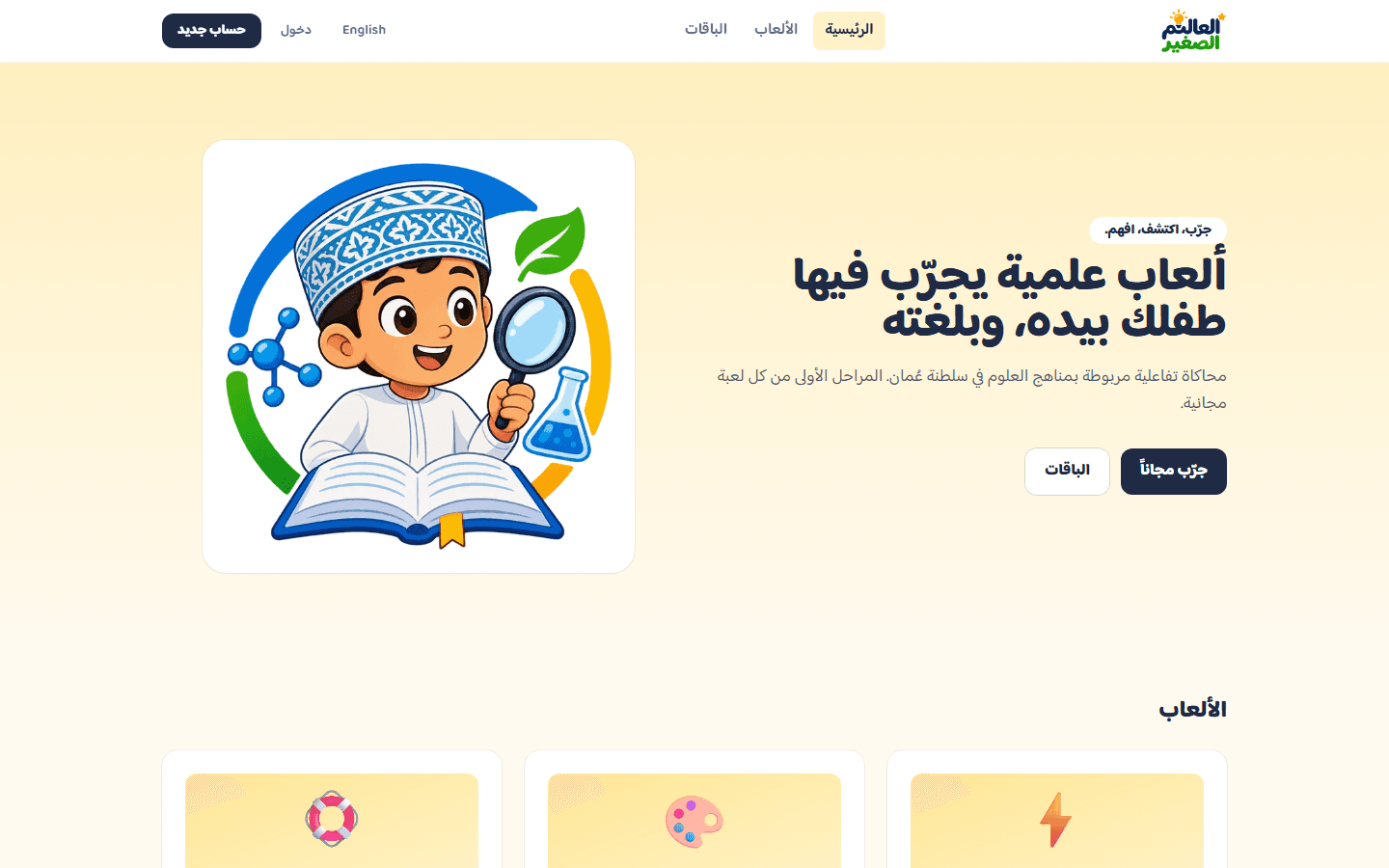
Little Scientist (العالِم الصغير) is an Arabic platform of interactive science games for children aged 6 to 12, tied to the science curriculum in Oman. Its line is "Try it, discover it, understand it" (جرّب، اكتشف، افهم).
Most good interactive science material for children is in English; in Arabic it is mostly videos or multiple-choice quizzes. Little Scientist gives children real simulations to try with their own hands, in their own language, with examples from around them: a falaj in the water cycle, a date palm in the plant game.
It is built for three kinds of adult. Parents want a screen that is worth the time, teachers want a ten-minute activity for the smart board, and schools want something tied to the curriculum. The account always belongs to the adult; the child just plays. There are no ads and no trackers.
It is live and free to try at playlittlescientist.com. Every screenshot on this page was taken there.
(02) — Implementation
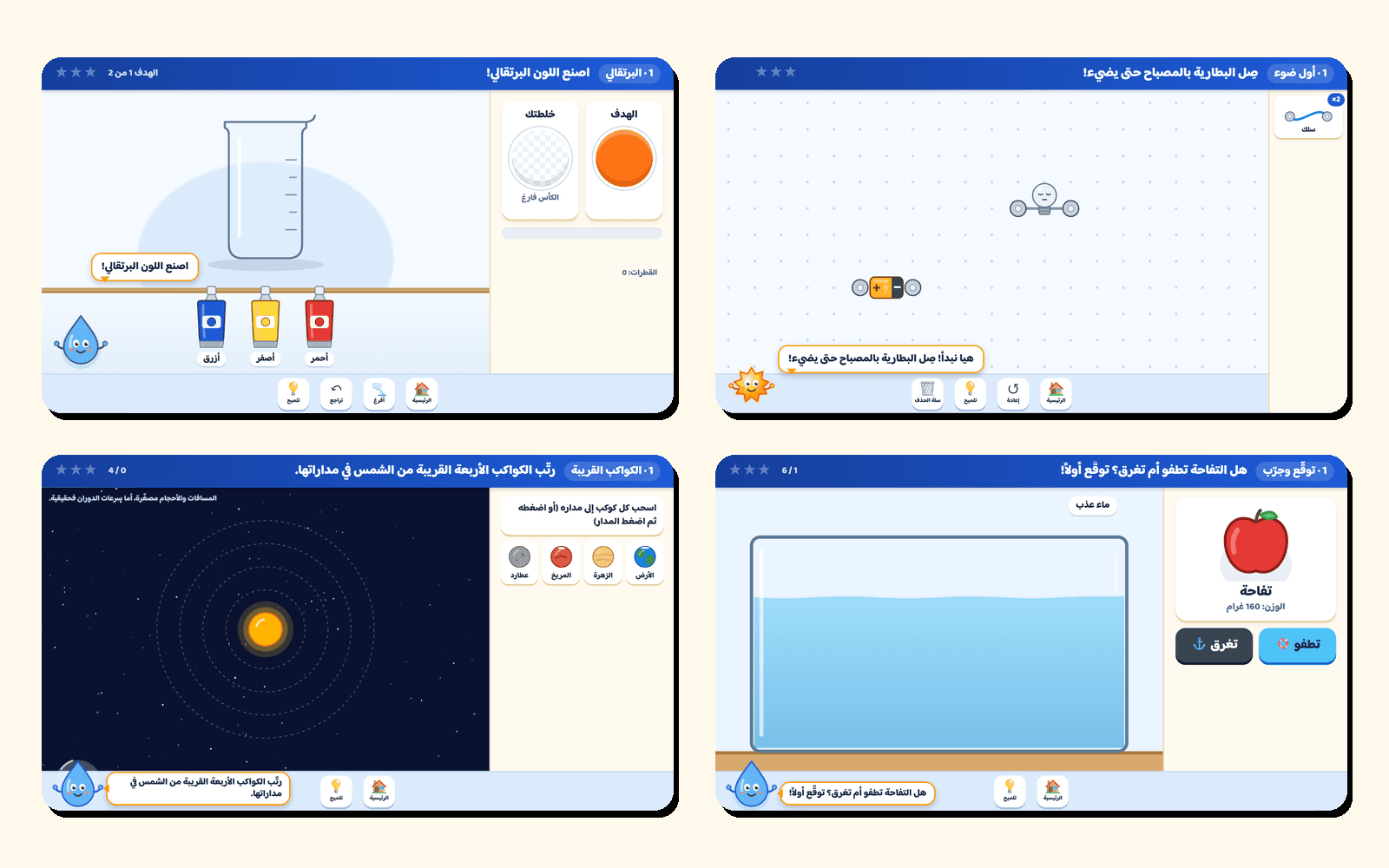
Eight games are live, with 49 levels between them:
- Build a Circuit: wire batteries, bulbs, a fan and a bell.
- Colour Mixing Lab: mix paint drops, then see how mixing light differs from mixing paint.
- Float or Sink?: predict, then try, and build a boat from clay.
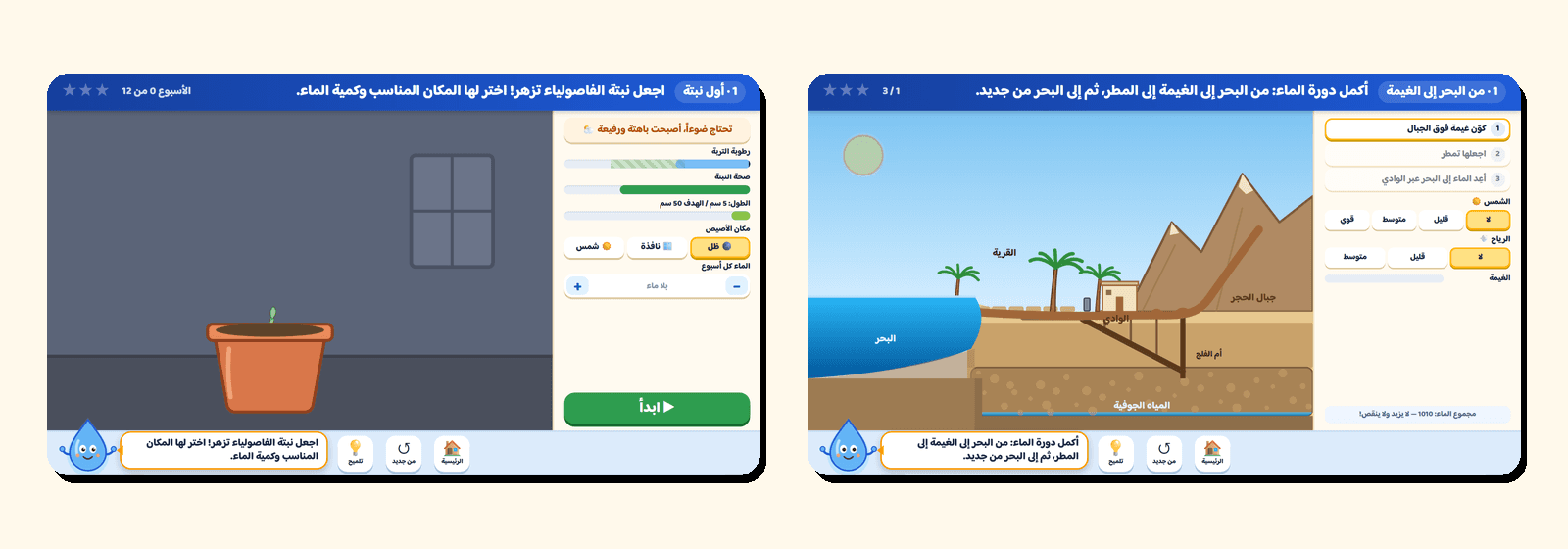
- Feed the Plant: grow a bean plant, a date palm and a frankincense tree.
- The Solar System: put the planets in their orbits.
- The Water Cycle: from the sea to the cloud, the wadi, groundwater and the falaj.
- Who Eats Whom?: a food web of plants, plant-eaters and predators.
- The Human Body: organs and bones, and a heart and breathing that follow activity.
The first levels of every game are free, and a membership opens the rest.
Behind the play is real science, each in its own small model file:
- Paint mixes with the two-constant Kubelka–Munk model, and light mixes additively.
- Floating follows Archimedes, including salt water.
- The plant tracks soil moisture, drainage and evaporation.
- The planets use real data and Kepler's law.
- The food web is a predator–prey (Lotka–Volterra) model.
- The water cycle moves a fixed amount of water between the sea, the air, the cloud, the wadi, the groundwater and the falaj.
The platform is Laravel 12 with MySQL, Blade and Tailwind CSS, right-to-left, in Arabic and English, with a Filament admin panel. It runs as a Docker image on Coolify.
(03) — Challenges
- Locked levels must stay locked. Every level, free or paid, lives on the server only. The game engines in the browser ship with no levels at all, and a single service decides which levels a visitor may receive. A paid level never reaches a browser that has not paid, so it cannot be dug out of the page.
- Science a child can trust. The models are simplified for children, but they are not faked. Each game's science has its own tests in Node, and they run with the rest of the test suite.
- Payment without a payment gateway. Families and schools in Oman pay by bank transfer, so a membership is ordered on the site, paid, and confirmed over WhatsApp, then activated by hand from the admin panel. The panel lists orders with an activate button, subscribers, memberships ending within 14 days, and a log of every action. Access closes on its own when a membership ends, and trial codes can be redeemed.
- A version for school fairs. The original circuit game still runs offline as a kiosk, unchanged, for science fair days without internet.
(04) — Outcome / Next
Live at playlittlescientist.com, with eight games, free levels in each, and plans for families, teachers and schools.
Next is a new game about once a month, and tying each game to the exact unit in Oman's science textbooks with a science teacher. That link is the strongest case for schools.